Why I'm Expanding to Amazon Canada — 40 Million People and a Brand to Protect
I wasn't planning to expand into Canada. Then I found my own products being sold on Amazon.ca by a seller I never authorized.
That's what pushed me north. If someone is going to list my brand in a market, I'd rather it be me — my pricing, my listing, my reviews, my control. Deciding where your products are sold isn't a nice-to-have. It's most of the reason you build a brand in the first place.
Canada is a real market, not a rounding error
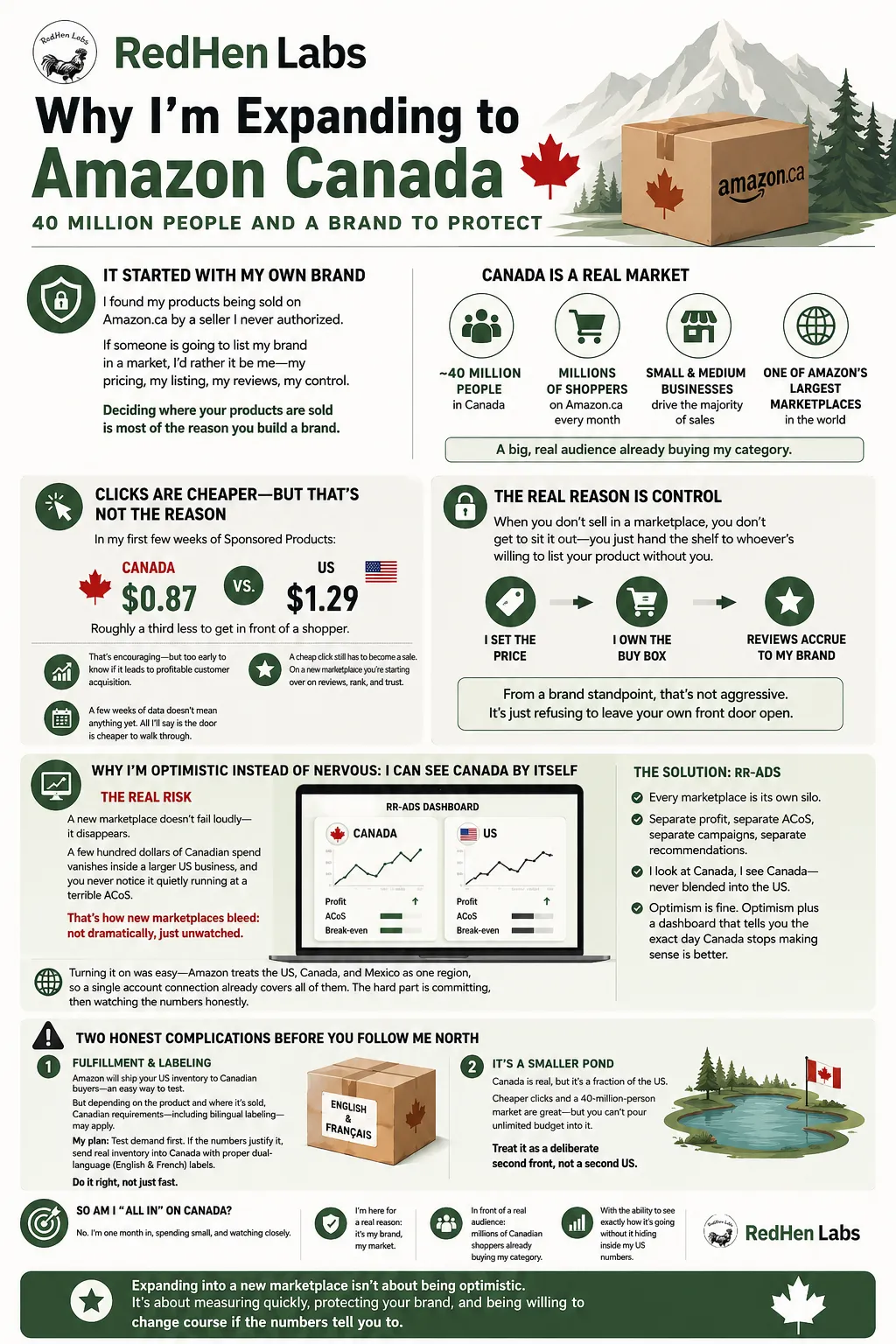
It helps that there's a genuine market waiting up there. Canada has about 40 million people, and Amazon.ca reaches millions of Canadian shoppers every month — small and medium businesses drive the majority of its sales, and it's one of Amazon's largest marketplaces in the world. So this isn't “expand everywhere because you can.” It's a big, real audience that's already buying my category — sometimes, apparently, from people who aren't me.
The clicks are cheaper — but that's not the reason
There's a practical reason to be optimistic, too: the ads cost less. Canadian ad auctions are less crowded than the US, so clicks generally come cheaper. In my own first few weeks running Sponsored Products on Canada, my clicks are landing around $0.87 versus $1.29 on the US — roughly a third less to get in front of a shopper.
That's encouraging — but it's still far too early to know whether those cheaper clicks translate into profitable customer acquisition. A cheap click still has to become a sale, and on a new marketplace you're starting over on reviews, rank, and trust. I'm not going to pretend a few weeks of data means anything. All I'll say is the door is cheaper to walk through than the US was.
The real reason is control
But the clicks aren't why I'm here. I'm here because it's my brand, and I want to decide how it shows up in every market I'm in. When you don't sell in a marketplace, you don't get to sit it out — you just hand the shelf to whoever's willing to list your product without you. Owning the listing means I set the price, I own the buy box, and the reviews accrue to my brand instead of to someone reselling it. From a brand standpoint, that's not aggressive. It's just refusing to leave your own front door open.
Why I'm optimistic instead of nervous: I can see Canada by itself
When you add a second marketplace, the real risk isn't that it fails loudly — it's that it becomes invisible. A few hundred dollars of Canadian spend and sales just vanishes inside a much larger US business, and you never notice it quietly running at a terrible ACoS. That's how new marketplaces bleed: not dramatically, just unwatched.
This is the reason I built RedHen Labs. Every marketplace is its own silo — separate profit, separate ACoS, separate campaigns, separate recommendations. When I look at Canada, I'm looking at Canada: its own real cost per unit, its own break-even, its own numbers, never blended into the US. That's the only reason I'd tell another seller to expand right now. Optimism is fine. Optimism plus a dashboard that will tell you the exact day Canada stops making sense is better. You can try it free for 14 days.
Turning it on was mechanically easy, too — Amazon treats the US, Canada, and Mexico as one region, so a single account connection already covers all of them. The hard part was never the plumbing. It's committing, then watching the numbers honestly.
Two honest complications before you follow me north
Fulfillment and labeling. Amazon will happily ship your existing US inventory to Canadian buyers for you, which is the easy way to test a market. But my products are physical goods with labels, and depending on the product and where it's sold, Canadian requirements — including bilingual labeling — may apply. A US label on a Canadian doorstep isn't always going to cut it. So my plan is deliberate: test demand with what Amazon makes easy, and if the numbers justify it, send real inventory into Canada with proper dual-language, English-and-French labels. I'd rather do it right than inherit a compliance headache later.
It's a smaller pond. Canada is real, but it's a fraction of the US. Cheaper clicks and a 40-million-person market are great, but you can't pour unlimited budget into it the way you can down here. Treat it as a deliberate second front, not a second US.
So am I “all in” on Canada?
No. I'm one month in, spending small, and watching closely. But I'm here for a real reason (it's my brand, my market), in front of a real audience (millions of Canadian shoppers already buying my category), with the ability to see exactly how it's going without it hiding inside my US numbers.
Expanding into a new marketplace isn't about being optimistic. It's about measuring quickly, protecting your brand, and being willing to change course if the numbers tell you to.
Frequently asked questions
Is it worth advertising on Amazon Canada?
It can be, but treat it as a deliberate, smaller second market rather than a second US. Clicks are generally cheaper and there is a real audience — about 40 million people — but cheaper traffic still has to convert, and on a new marketplace you start over on reviews and rank. The key is to watch Canada's own profit and ACoS separately from your US numbers, so a small new marketplace cannot quietly lose money unnoticed.
Are Amazon PPC clicks cheaper in Canada than the US?
Generally yes — the Canadian ad auction is less crowded, so cost-per-click tends to run lower. In my own first few weeks on Amazon.ca, my clicks came in around $0.87 versus $1.29 on the US, roughly a third less. But cheaper clicks are not the same as profit; a cheap click still has to turn into a sale on a marketplace where you are rebuilding reviews and rank.
Do I need a separate Amazon account to sell in Canada?
No. Amazon treats the United States, Canada, and Mexico as one North America region, so a single account and one authorization already cover all three. You can start seeing Canadian data without setting up anything separate — the hard part is committing, then watching the numbers honestly.
Do I need French labels to sell in Canada?
It depends on the product and how it is sold. If you ship inventory into Canada, plan for Canadian labeling requirements, which can include bilingual English-and-French labeling. The easiest way to test the market first is Amazon's program that ships your existing US inventory to Canadian buyers, then move to local, properly labeled inventory if the numbers justify it.
Related reading
Ready to automate the right way?
RedHen Labs combines rules with AI — and keeps you in control.