Amazon PPC for manufacturers: lower COGS, longer lead times and the ability to change the product itself set it apart from reseller advice.
I make wood-finishing products — hardwax oils, cutting board gel, furniture oils — and I run the Amazon ads on all of them myself, every day. About 13 products, most of them FBA. Most Amazon PPC advice is written for someone who buys products wholesale and resells them, and if you make what you sell, a lot of it doesn't fit. Here's what actually changes when you're the manufacturer.
Your COGS is much lower — use it in the auction
Everyone says “know your COGS.” The real edge isn't knowing it — it's that yours is much lower than a reseller's. They buy wholesale and mark it up; their cost is mostly out of their hands and their margin is thin. I make mine, so my cost is a fraction of the retail price, and I know it to the penny — materials, labor, packaging, freight to Amazon.
Lower cost means a higher break-even ACoS. Mine run 41% to 57% depending on the product — not the 25% number the gurus throw around. On the exact same keyword, I can bid more than a reseller can and still make money. When we're both fighting for “food safe cutting board oil,” they tap out at a break-even the wholesale math won't let them cross. I don't. That gap is the manufacturer's advantage — and most sellers who have it never use it, because they bid like their break-even is 25%.
PPC isn't just feedback for your ads — it's feedback for your product
This might be the biggest advantage of all, and almost nobody talks about it. A reseller can change three things: bids, the listing, and price. As a manufacturer, I can change the product itself — formulation, packaging, bottle size, instructions, the bundle, the inserts, the label.
That turns PPC into a product-development tool. When a search term gets clicks but converts poorly, a reseller shrugs and negates it. I ask why — often it's because the people searching that term expect something a little different than what I made. Sometimes the fix isn't a bid or a negative keyword; it's a different size, a clearer line on the label, or a bundle that matches what buyers are actually shopping for. A reseller can't touch any of that. My ad data doesn't just tell me how to advertise the product — it tells me how to make a better one.
Longer lead times mean less room to bail — so you optimize instead
Many resellers have more flexibility to discontinue a poor performer than a manufacturer does. (Plenty of private-label sellers don't — molds, trademarks, and long lead times commit them too — but as a category, resellers can pivot faster.) I can't drop a product on a bad month; I've got tooling, recipes, and inventory tied up in it for the long haul. So instead of asking “should I kill this,” I'm always asking “how do I make this work” — judging every campaign continuously and optimizing rather than abandoning.
Fewer products means you concentrate, not spread
A reseller might have 200 SKUs across fifteen categories with a budget stretched thin across all of them. I have about 13 in one focused niche, and each product has its own campaign structure — discovery, research, and harvesting — so every one produces enough data to improve over time. You're not averaging $5,000 across 200 listings and hoping; you're concentrating it where each product can actually be optimized.
Running out of stock is a production problem, not a reorder
This is the one resellers rarely think about. If a reseller sells out, they reorder from a wholesaler and restock in days. If I sell out, I have to make more — and then it's a minimum of about two weeks just to get new inventory into Amazon's network once they pick it up, longer near the holidays or if they have a receiving hiccup. Add production on top and a stockout means weeks of your ranking sliding while competitors take the positions you paid to earn.
So I don't advertise flat-out until the shelf's empty. I tie ad aggression to inventory: as days-of-supply falls toward my threshold — mine's at 45 days — the system automatically pulls bids down rather than pausing (I'd rather run leaner than go dark), then eases back up once stock recovers. Bidding hard on a product you're about to run out of is just paying to lose your rank.
You're the brand — which is exactly why you don't run ads at a loss
Every reseller sells someone else's product; you sell yours, so every impression is a brand impression. The part people get wrong is using “brand-building” as an excuse to run ads that lose money and calling it patience. I don't. I'm genuinely averse to working for Amazon for free — spending on ads that don't come back as profit.
On my account, Sponsored Brands Video campaigns consistently outperform Sponsored Products on ACoS — so I run them, and they're all video. But there's an honest catch most SB advice skips: Sponsored Brands is only worth it if you own your buy box and you're brand-registered. If you don't own the buy box, your brand ad can end up making a competitor's sale on your own listing. Being the brand is a real advantage — one you use to earn, not an excuse to spend.
Manufacturing changes the economics of advertising. Lower costs, longer production cycles, tighter inventory constraints, and — most of all — the ability to change the product itself mean manufacturers should optimize differently than resellers. The generic, ACoS-chasing playbook leaves most of that advantage on the table.
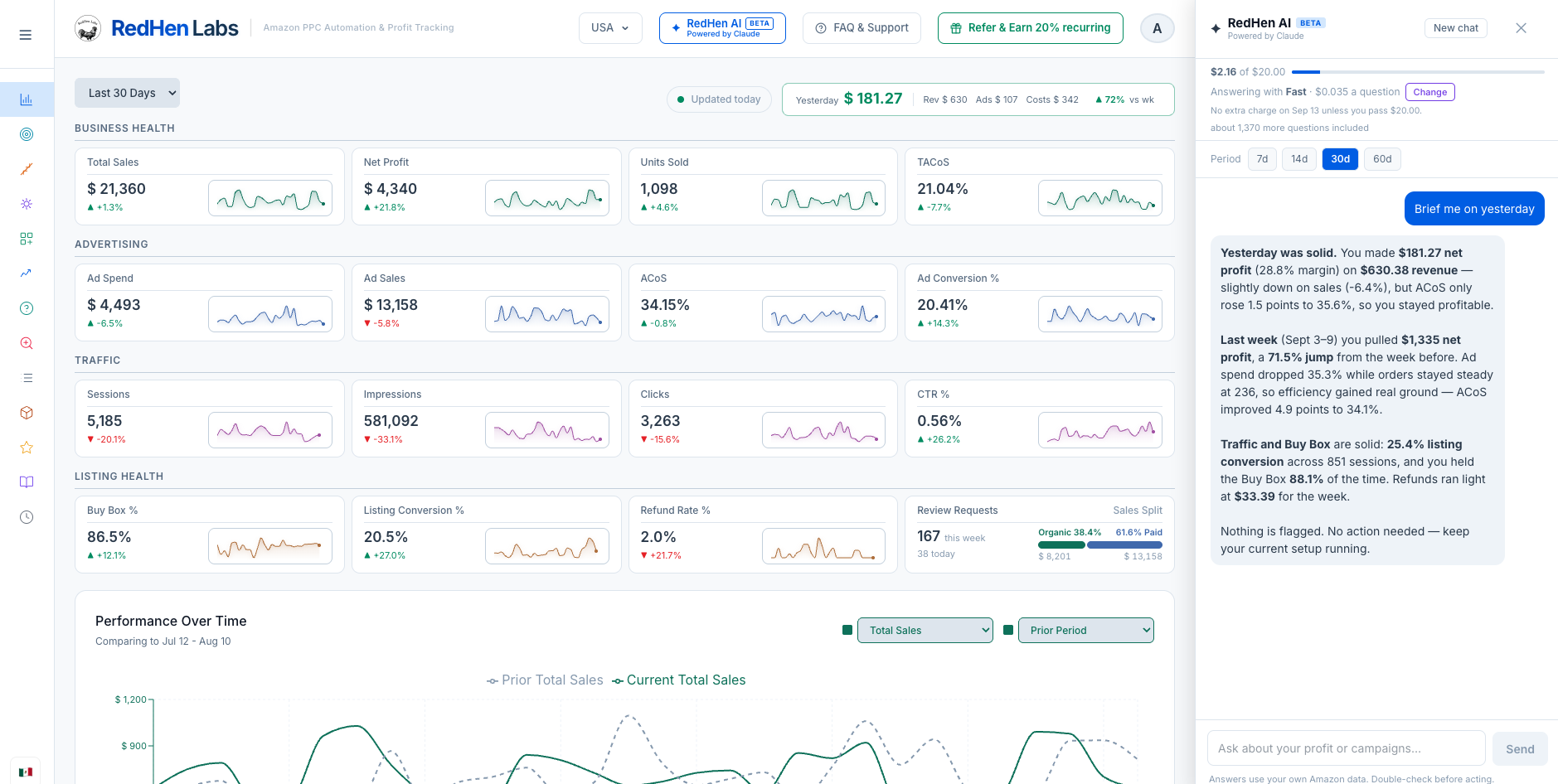
That's the gap I built RedHen Labs to close — for how I actually run Rowdy Rooster. It tracks real profit per product after COGS, FBA fees, ad spend, and returns; the automation can factor in your inventory levels; and it's $129/month flat for unlimited products, because your tools shouldn't get more expensive just because your business is working. Try it free for 14 days.

.png) Partner
Partner