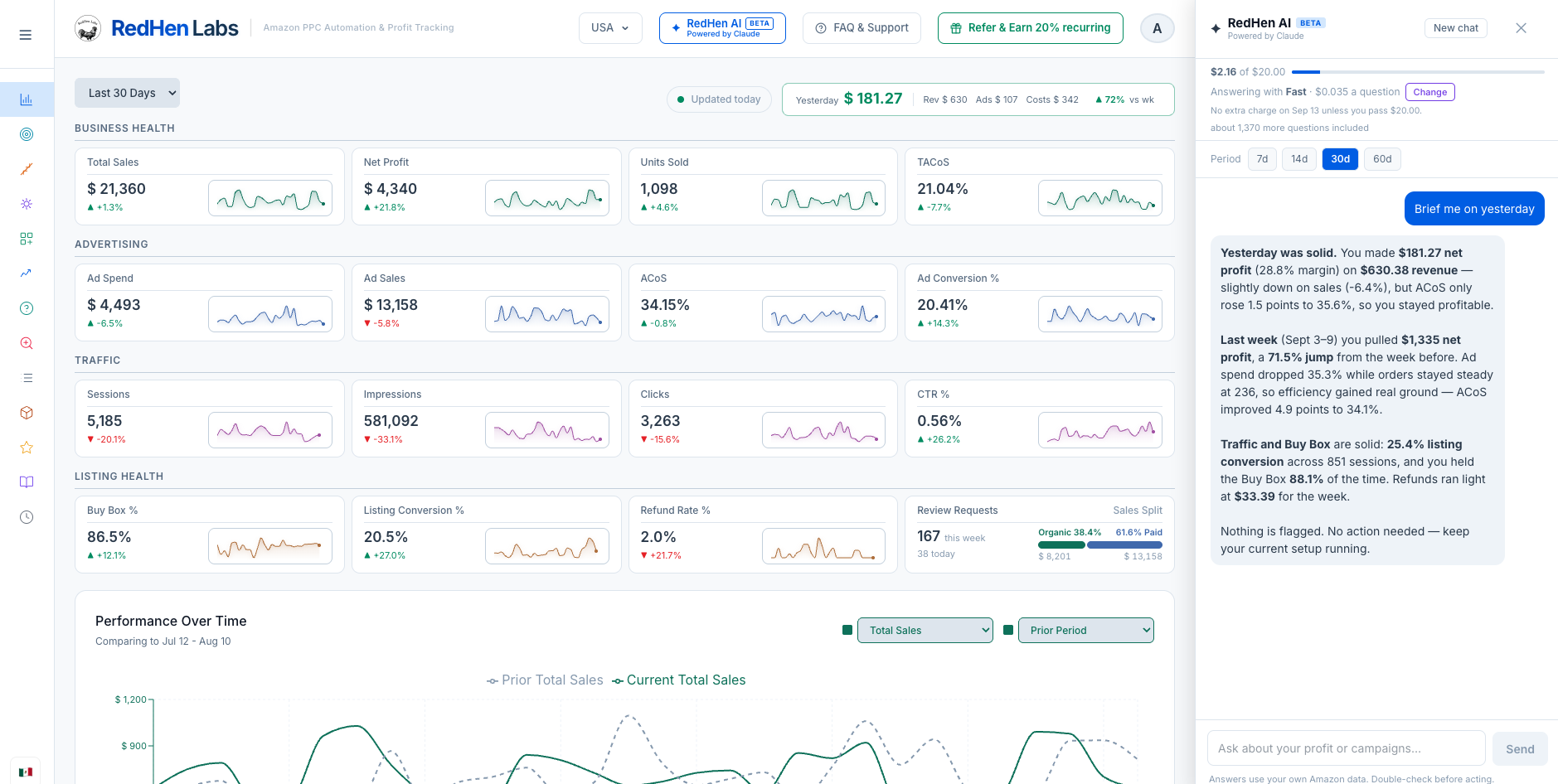
How much to spend on Amazon PPC: I set a TACoS ceiling, not a budget, and let profitable campaigns spend. My break-even ACoS runs 42-50%, not 25%.
On my own Amazon account, I don't set a PPC budget. I set a TACoS ceiling and let the account spend as much as it profitably can. I don't tell Amazon to spend $4,700 — I tell it not to exceed my acceptable TACoS. The spend is the result, not the goal. That's the opposite of how "how much should I spend on PPC" usually gets answered, so here's how I actually think about it on Rowdy Rooster Woodworks.
The gate nobody mentions: can this product even afford to be advertised?
Before you ask how much to spend, ask whether the product's math supports advertising at all. As a rule of thumb, I get skeptical once the landed cost of a unit — what it costs me to make it and ship it into Amazon — climbs much above 20% of the retail price. Many small sellers will struggle past that line; some high-margin brands can still advertise profitably above it, but they're the exception. The reason is simple: Amazon takes its cut first (referral plus FBA is often 30-40% of the price), then PPC takes a bite, then you still have overhead.
On my HardWax Oil, the product costs me $4.50 to make on a $28.46 listing — about 16%. On my Cutting Board Gel, $2.55 on $17.13 — about 15%. That leaves room. If my landed cost were 35-40% of retail, there'd be little left to advertise with, and no budget framework would fix it.
Know your real break-even — it's not 25%
The most repeated PPC advice is "keep ACoS under 25%." On my products that rule leaves money on the table. Start with the per-unit math:
Pre-ad margin = Selling price − COGS − inbound shipping − referral fee − FBA fee
Break-even ACoS = Pre-ad margin ÷ Selling price
On my HardWax Oil: $28.46 − $4.50 − $0.75 − $4.27 − $4.76 = $14.18 before ads. That's $14.18 ÷ $28.46 = a break-even ACoS of about 50% — I can spend up to half the sale price on ads and still not lose money. Cutting Board Gel works out to about 42%. So "keep ACoS under 25%" isn't cautious on my catalog; it's leaving half my available spend unused. Your break-even is different for every product, and it's almost never 25% — the 25% rule misleads in both directions.
Budget is an output, not an input
Here's the core of it. Once you know a product can afford advertising and what its break-even is, you don't need a monthly budget number — you need a TACoS you're comfortable with. TACoS — total ad spend as a share of total sales — tells you whether your advertising is lifting the whole business or just moving money around. As long as mine stays in a healthy range, I let profitable campaigns spend. When it drifts up without sales following, that's the signal to pull back — not a number on a calendar. A budget cap punishes your winners; a TACoS ceiling lets them run.
Allocate by margin, not by revenue
Most sellers put the most spend behind their best sellers. That feels intuitive but it's often wrong — your best seller might have the thinnest margin. (This is exactly why PPC decisions need real profit data.) Rank your products by pre-ad margin per unit, not revenue or units sold. The ones with the most room per unit are the ones that can carry the most profitable spend. Shift budget toward them.
Cutting vs. defending — the judgment that actually matters
The usual advice is "kill what doesn't work." Too blunt. Some of my highest-ACoS terms are non-negotiable, because they aren't just keywords — they're the product's identity. "Refined walnut oil for wood" is the exact term for a product I own outright; "cutting board gel" is effectively my category. They run hot and I still defend them, the same way you'd never stop bidding on your own brand name. The skill isn't cutting the expensive terms — it's knowing which you must hold and which you can let go, per product and per term. That's where a brand-aware view earns its place.
On launches: slow and steady beats buying rank
The popular launch move is to dump budget to win rank early — spend way over break-even to please the algorithm. I don't. Maybe it helps the ranking; maybe it doesn't. I'm in business to make money, not to gamble on where A9 or A10 puts me this week. I launch profitably and let the product build. It's slower — but I'm never left holding a pile of unprofitable spend if the algorithm doesn't cooperate.
The real question
"How much should I spend on Amazon PPC?" is the wrong question. The right ones: can this product's math support advertising at all, what's its real break-even, and is my TACoS still healthy? If the answers are yes, spend — and let the good campaigns run. If they're no, no budget number will save you.
This is why RedHen Labs calculates your pre-ad margin and break-even ACoS for every product from your real COGS, shipping, referral, and FBA fees, tracks your TACoS over time instead of just per-campaign ACoS, and flags — with a brand-aware view — which high-cost terms are worth defending. You see how much room you actually have before you spend a dollar. See your real margins — try it free for 14 days.

.png) Partner
Partner