Amazon PPC tool pricing in 2026, side by side: a flat monthly fee vs a percentage of ad spend, the hidden fees, and what each does to your margin.
I run my own Amazon seller account (Rowdy Rooster Woodworks) and evaluated most of the available Amazon PPC tools before settling on what to use. The pricing models I encountered all scaled with my success in one form or another — a percentage of ad spend, a percentage of sales, a bundled subscription that grew with tier upgrades. After enough demos, I spent about eight months and roughly $30,000 building a platform with a different shape. This article is a calm walk through what those pricing models look like in 2026, what each implies for the operator, and what we chose to build instead.
Yes, the writer of this article sells a tool. The bias is real. The math is also real, and you can run it yourself with your own numbers.
The four ways tools charge for PPC management
There are essentially four pricing structures in the Amazon PPC software market. Each implies a different relationship between your account and the vendor's revenue.
-
Percentage of ad spend — typically 2-10% of what you spend on ads each month, often with an undisclosed monthly minimum. As your ad budget grows, so does the vendor's revenue from your account. Common with platforms marketed toward larger sellers and brands.
-
Percentage of sales — more common with agencies than software, usually 10-15% of your Amazon revenue. Tied to revenue rather than ad spend, which means the vendor benefits from every dollar your account earns, including dollars earned organically with no ads involved.
-
Suite bundles — flat monthly fee tiered by feature set. PPC management is one module among several (product research, keyword tools, rank trackers, listing optimizers, etc.). Tier upgrades unlock more modules.
-
Flat rate — the same monthly fee regardless of ad spend, sales, or catalog size. Less common because it's harder to grow vendor revenue against a single seller.
All four models have legitimate use cases. The question for an operator isn't which is "good" or "bad" — it's which one's incentives are best aligned with the outcome you actually want, which is usually: less ad spend, more profit, less time.
The incentive question
A useful exercise: for each pricing model, ask what the vendor wants you to do, and whether it matches what you want to do.
-
Percentage of ad spend earns the vendor more when you spend more on ads. Reducing waste in your account — a primary goal for most sellers — reduces the vendor's revenue from your account. The misalignment is small at first but compounds as you scale.
-
Percentage of sales earns the vendor more when your overall business grows, including portions of the business the vendor wasn't involved in (organic ranking, repeat purchases, off-Amazon traffic). Most operators eventually find this hard to justify.
-
Suite bundles earn the vendor a fixed amount per month, but their growth strategy depends on you upgrading tiers as your account grows. That tends to mean adding features rather than improving the ones already there.
-
Flat rate earns the vendor the same regardless of your performance. The vendor's only path to long-term revenue is keeping you subscribed, which means the product needs to keep doing the job. Closest alignment with operator outcomes, in our view, which is why we picked it.
A note on setup fees and minimums
Several of the higher-tier platforms and agency-style offerings have starting costs that aren't on the public pricing page — onboarding fees in the $500-$3,000 range, monthly minimums that override the percentage at low spend levels, or quarterly commitments with cancellation terms. Worth asking about in writing before signing.
The math at $10,000/month ad spend
To put numbers on it, here's roughly what a year of each pricing model costs a mid-tier seller running $10,000/month in Amazon ads (and somewhere around $30-40K/month in associated revenue):
- Percentage of ad spend (5% of $10K/mo): $6,000/year — rises as you scale
- Agency retainer ($2,500/mo): $30,000/year
- Agency percentage of sales (12% of $35K/mo revenue): $50,400/year
- Suite bundle (mid-tier): $2,400-$4,800/year
- RedHen Labs flat rate ($129/mo): $1,548/year — same price at $10K or $100K monthly ad spend
Across the range, the gap between flat-rate and the next-cheapest option grows as you scale. That's the practical consequence of incentive alignment showing up as a number.
What we built and why
The product philosophy behind RedHen is straightforward: an experienced Amazon seller needs systems and automations that handle the volume, and they need the most important data filtered and presented the way a high-level CEO consumes information — not a 14-tab dashboard with every conceivable metric vying for attention. The point is to know what to do and have the system already doing the routine version of it.
That philosophy shapes a small number of opinionated design choices:
-
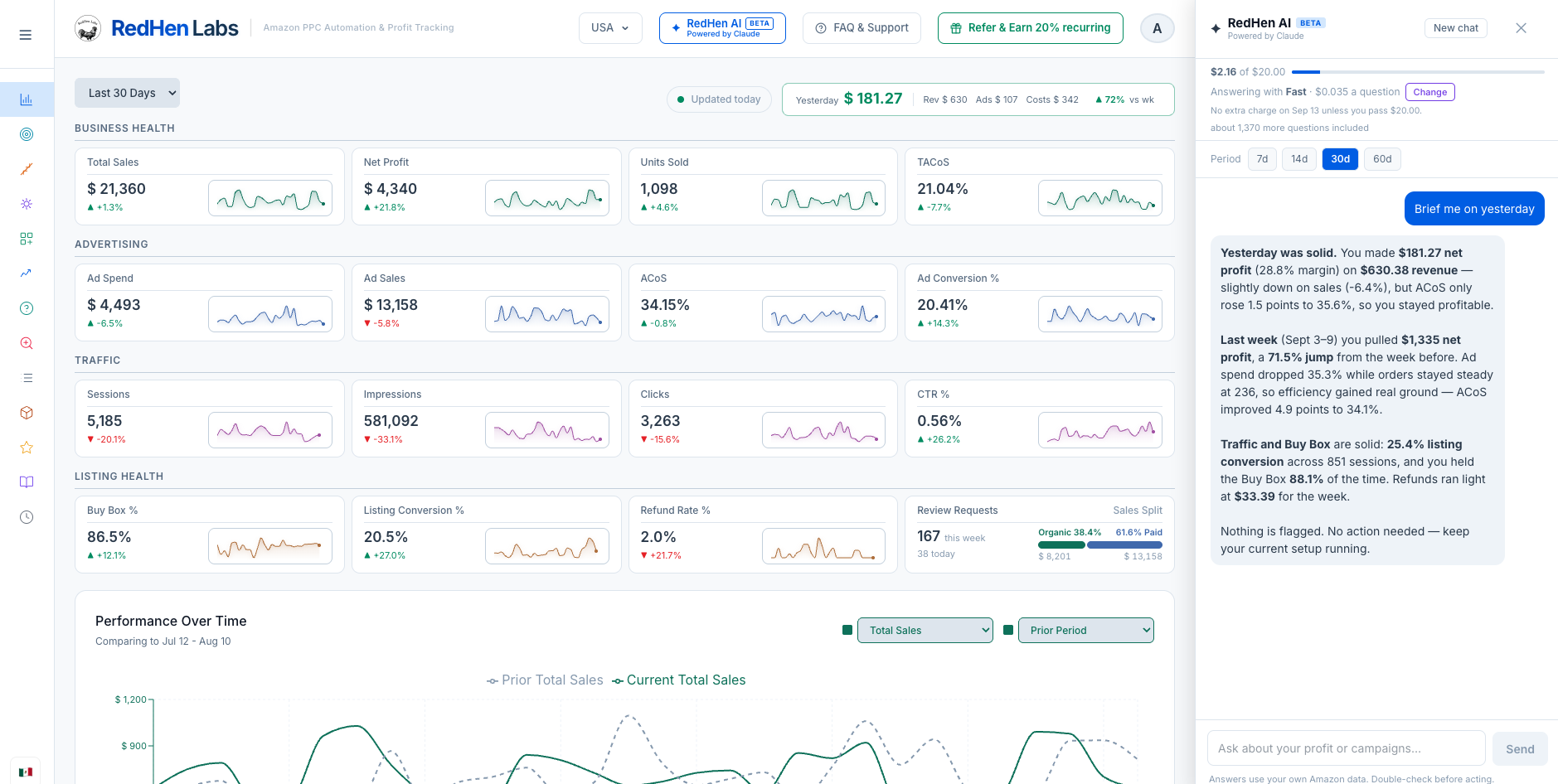
Real profit tracking, not just ACoS. Every product carries its actual COGS, FBA fee, referral fee, and an estimated return cost. The dashboard shows true profit per product, per campaign, and per ASIN — not just ad-attributed revenue divided by ad spend.
-
Automation with a human review layer. Bid changes, keyword harvests, and negative-keyword additions are generated by the system but require your approval before they ship to Amazon. The point is to remove the spreadsheet work, not to remove operator control.
-
Configurable bid nudges. Rather than picking one bid and walking away, the system cycles bids in small increments at a rate you set. Winners surface faster; losers get pulled back without manual monitoring.
-
Focused scope. We don't ship a product-research module, a Chrome extension, a supplier database, or a rank tracker. Those tools exist if you want them. The job of this platform is to optimize the account you already have.
-
Flat pricing. $129/month regardless of ad spend, catalog size, or campaign count. The pricing is the pricing.
None of this is revolutionary. It's the version of an Amazon PPC tool that an operator would build if their goal was to run their own account better, rather than to maximize the price they could charge other operators. That's the whole pitch.
The summary
If you're evaluating Amazon PPC tools, the most useful filter isn't a feature checklist. It's the pricing model. Ask what the vendor earns when your account performs better. The answer tells you most of what you need to know about whether they're built to help you.
RedHen Labs is $129/month flat. See the full pricing or start a 14-day free trial — no charge today.
.png) Partner
Partner