Can Claude or ChatGPT Run Your Amazon Ads? Why We’re Still Not Building an MCP
The short version
- AI chat apps are useful for one-off questions about your ad account, like what changed or which campaigns lost money.
- They aren't built to run an account: the same request can get different answers, they can't see your margins or inventory, and a connection doesn't enforce your bid limits.
- RedHen Labs' rules do the repetitive work the same way every time, and by default every change its AI suggests waits for your approval.
- RedHen Labs' AI runs on Anthropic's Claude models through Anthropic's commercial API, which doesn't use your data to train its models. We won't send your ad data to an AI app whose settings we can't see.
- You can still try chat without a connector: download a report from the Amazon Ads console, check the app's data settings, and paste it in.
A few sellers have asked whether they can connect their RedHen Labs account to Claude or ChatGPT. It's a fair question. Several Amazon PPC tools now offer an MCP connection, and the pitch is hard to resist: type "fix my account" into a chat window and watch it happen.
We looked at it again, carefully, this month. We're still not building one. Here's why, what a month of AI decisions on our own brand showed us, and what AI chat is actually good for with your Amazon ads data.
If you want the cost side, meaning what MCP services charge and what Amazon's own server costs, we covered that in Should You Pay for an Amazon Ads MCP?
The appeal is real
An MCP connection plugs an AI chat app into your ad account. Instead of filtering a search term report by hand, you ask "why did my spend jump last week?" in plain English and get an answer drawn from your own numbers. Some connections also let the AI change bids, pause keywords or move budgets.
For one-off questions, that's useful. What changed? Which campaigns lost money this month? Where should I look first? Chat is a fast way in.
The trouble starts when "ask the AI a question" turns into "let the AI run the account."
Why "fix my account" doesn't work
The same question gets different answers. Try this yourself: open three new chats and ask each one to grade the same list of search terms. You may get letter grades in one, percentages in the next and a 1 to 10 scale in the third. That's fine for brainstorming. It isn't fine for something that touches your bids every day. A rule gives the same answer to the same data every time.
Your ad data doesn't know your business. Your margins, your inventory, the stock-out coming next week, the listing you just rewrote, the product you're launching at a loss on purpose: none of that lives in your Amazon ads data. When we're pushing one of our products up the Best Sellers Rank, we turn down some bid cuts on purpose to keep the push going. No ad report knows that.
A connection doesn't enforce your limits. It passes data and actions back and forth. It doesn't know your maximum bid, the keywords you never want negated or the campaign that's still building rank.
It can be confidently wrong. AI models misread numbers and mis-summarize correct data, and they rarely sound unsure when they do.
None of this makes AI useless for Amazon ads. It means AI should act only inside limits you can list, with every change logged and one click from undone. We wrote a whole post on that: The Black Box Problem With AI Amazon PPC (and the Fences I Use).
A month of AI decisions on our own brand
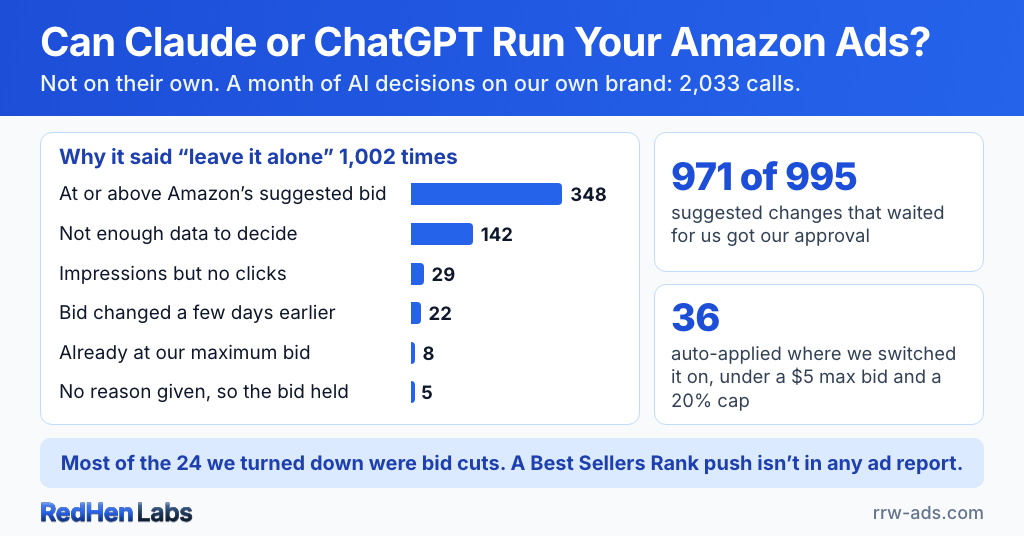
We run our own Amazon brand, Rowdy Rooster Woodworks, on RedHen Labs. Here's what its AI manager did in the 30 days to November 7, 2026:
- It made 2,033 calls on 617 keywords and targets across 42 campaigns.
- 1,002 of those calls, about half, were "leave it alone." The most common reasons, mostly in its own words:
- 348 times, the bid was already at or above Amazon's own suggested bid, so raising it wouldn't help.
- 142 times: "Not enough data to make a meaningful decision. Will re-evaluate next cycle."
- 29 times, a keyword had impressions but no clicks, which points to a relevance problem, not a bid problem.
- 22 times, the bid had changed a few days earlier, so it waited for new data.
- 8 times, the bid was already at the maximum we set.
- 5 times, the model gave no reasoning, so RedHen Labs held the bid where it was. An answer without a reason doesn't get acted on.
- It's blunt about thin data. Two of its notes, word for word: "ACoS looks great but 1 order on 3 clicks is statistically meaningless — a single bad click changes everything." And: "Data thickness test: adding 1 more order swings ACoS dramatically."
- It suggested 1,031 changes. 995 waited for us, and we approved 971 of them. We turned down 24, and 17 of those were bid cuts: about 1 in 5 of the cuts we reviewed, against almost none of its raises. Cuts are where our own context matters most, like the Best Sellers Rank push above.
- The other 36 applied on their own, from two profiles where we've switched on auto-apply, each with a $5 maximum bid and a 20% cap on any single change.
That's the job we want AI doing: careful calls inside limits we set, saying so when it doesn't know, and leaving the business decisions to us.
Where AI belongs in RedHen Labs
RedHen Labs uses Claude too. Our AI runs on Anthropic's Claude models, inside the app, where it can see your rules and your limits:
- Rules do the repetitive work, the same way every time, and bid rules work within a maximum bid you set.
- AI points out what's worth a look. It gets the same instructions and your limits on every run, and its answers are checked against those limits before they become suggestions. By default, every change it suggests waits for your approval.
- Auto-apply is there when you're ready. Once you've reviewed enough of its suggestions and trust your guardrails, you can let a profile apply them on its own, inside the same limits. We still encourage as much involvement as you can give it. It's your money.
- You choose how far back it looks. We use 30 or 90 days, depending on how quickly we want the automations to respond: a shorter window reacts faster, a longer one is steadier.
- Every change is logged in History, and most can be undone there.
- When there isn't enough data, it says so. Instead of guessing, it returns: "Not enough data to make a meaningful decision. Will re-evaluate next cycle."
That's what a chat window can't give you: suggestions that pass through your own guardrails before anything reaches Amazon.
We'd rather know where your ad data goes
Every outside connection is one more place your ad data lives: chat histories, shared chat links, and whatever training setting that AI app happens to have switched on. Once data leaves RedHen Labs, we can't see any of that, let alone control it.
RedHen Labs' own AI runs on Anthropic's commercial API, which doesn't use your data to train its models. That's one AI provider, under one set of written terms, listed on our Security page. We'd like to keep that list short.
If you want to try chat anyway
Go ahead. You don't need a connector. Download a report from your Amazon Ads console and check that app's data settings first: turn off training on your chats if it's on. Then paste the report in and ask questions. You'll learn fast what it's good at (brainstorming, spotting patterns, drafting a negative keyword list) and what it isn't (doing the same thing the same way twice). Then bring the decisions back to where your rules and limits live.
Not now
We're not building an MCP. If more sellers running real ad budgets tell us chat access would change how they work day to day, and we can do it without loosening a single guardrail, we'll look again. Until then, our time goes into the parts that move your bottom line.
We run Rowdy Rooster Woodworks on RedHen Labs every day. We wouldn't hand its ads to a chat window either.
There's no magic button for Amazon PPC, and a chat window isn't one. We don't sell certainty. We sell control.
Frequently asked questions
Can Claude or ChatGPT manage my Amazon ads?
They can answer questions and draft ideas. Running an account day to day takes consistent decisions, your business context and enforced limits, which a chat connection doesn't provide on its own.
Does RedHen Labs connect to Claude or ChatGPT?
Not to your own Claude or ChatGPT app. RedHen Labs' AI uses Anthropic's Claude models inside the app, through Anthropic's commercial API, which doesn't use your data to train its models. By default, every change it suggests waits for your approval.
Why does AI give different answers to the same question?
Chat models write each answer fresh, so the wording, scoring and conclusions can shift from one chat to the next. A rule applies the same logic to the same data every time.
How can I use AI chat with my Amazon ads data without a connector?
Download a report from the Amazon Ads console, check the AI app's data settings and turn off training on your chats if it's on, then paste the report in. Treat the answers as ideas to check, not decisions.
Ready to automate the right way?
RedHen Labs combines rules with AI — and keeps you in control.