Building a Brand on Amazon: What the Courses Leave Out
This is the last of four articles on the Amazon guru landscape. The first was about the courses, the second about wholesale and arbitrage, the third about product research. This one is about the model the courses talk about least: building a brand.
I make wood finishing products and sell them on Amazon, on Walmart, in stores and on my own website. Amazon is a great place to start a brand. What the courses leave out is what it costs, and what happens when Amazon is all you have.
The short version
- Amazon's referral and fulfillment fees take 33% to 48% of the price on my products, by Amazon's own estimates, and the cheaper the product the bigger the share, because the fulfillment fee is roughly fixed.
- Storage, inbound shipping and disposal are billed to the account on top: from May to October mine included $2,307 inbound, $267 storage and $256 disposal.
- After fees, product cost and freight, my gel leaves about 42% of its price for ads and profit, and most of that is fixed once the price and the product are set.
- Make Amazon one channel from the start, so a fee change or a lost Buy Box can't sink the business.
- A trademark and Brand Registry are a deterrent, not a wall; owning the product from concept to production is what makes a brand more than a listing.
The fees surprised me most
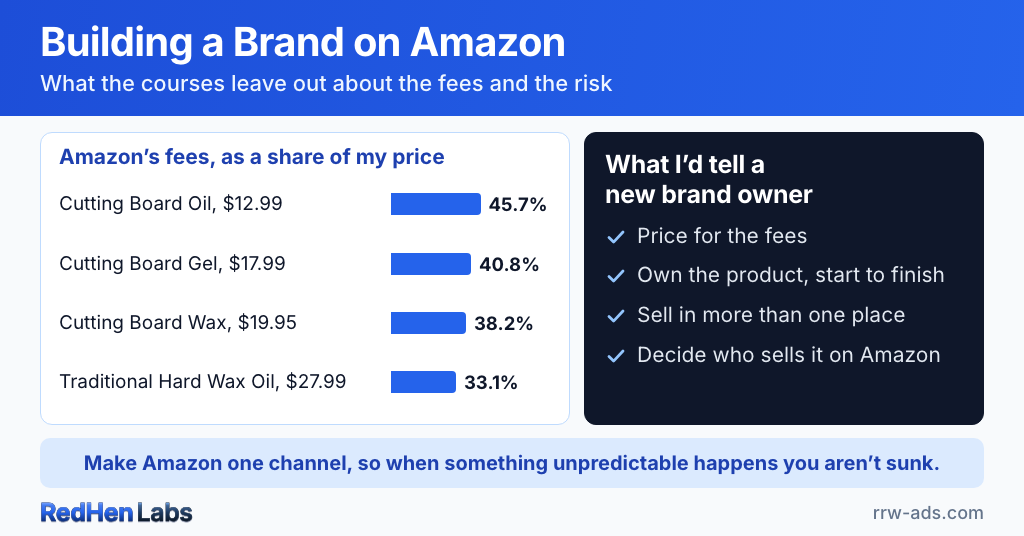
When I went from making my products to selling them on Amazon, the thing that surprised me most was the fees. Here’s what Amazon’s referral and fulfillment fees come to as a share of the price on my products, from Amazon’s own fee estimates today:
- Cutting Board Oil, $12.99: 45.7%
- Soft Paste Furniture Oil & Wax, $13.99: 48.2%
- Cutting Board Gel, $17.99: 40.8%
- Refined Walnut Oil, $17.99: 40.8%
- Cutting Board Wax, $19.95: 38.2%
- Traditional Hard Wax Oil, $27.99: 33.1%
The fulfillment fee is the same $4.64 on a $12.99 bottle as on a $17.99 one, so the cheaper the product, the bigger the share the fees take. That’s before the costs Amazon bills to the account rather than the sale: from May to October mine included $2,307 for inbound shipping and fees, $267 for storage and $256 for disposal.
Price for the fees before the first batch
On my gel, after Amazon’s fees, product cost and freight, about 42% of the price is left for ads and profit. That number decides what I can bid, and most of it is fixed once the price and the product are set. Work out yours before you order inventory. A course that shows you revenue without this math is showing you the part that doesn’t matter yet.
Make Amazon one channel, from the start
Amazon is a great start, but diversifying right away matters just as much. Make Amazon just another channel, so when something unpredictable happens you aren’t sunk.
Unpredictable things happen on Amazon all the time, and none of them are personal. In mid-October the fulfillment fee on my gel went from $4.35 to $4.64. In early November another seller started winning the Buy Box on my gel. Either one hurts a business that only sells on Amazon. I also sell on Walmart, in stores and on my own website, and none of those moved when Amazon did.
Own the whole product
I control my products from concept to market: the idea, testing for market fit, lab testing, package design and production. That’s what makes a brand more than a listing. The pretend brands in the product-research waves can disappear at the first problem because there’s nothing behind the name. A brand that owns its product has to stand behind it, and that’s the point.
Trademark and Brand Registry: a deterrent, not a wall
A registered trademark and Amazon’s Brand Registry are a deterrent. They give you tools to report sellers who copy your listing or your brand, and Brand Registry is also what lets a seller run Sponsored Brands ads. What they don’t do is stop a reseller with genuine stock from selling on your listing. That part comes down to who you sell to.
What I’d tell a new brand owner
- Skip the course. Put the money into the product.
- Price for the fees. Know what Amazon takes before you set the price.
- Own the product. Testing, packaging and production are what the customer holds.
- Sell in more than one place. Amazon as one channel, from the start.
- Decide who sells your product on Amazon, before the stock leaves your building.
- Expect the waves. Hold your place in units sold and let them pass.
Where I land
The courses sell Amazon as the business. For me it’s one channel of a brand I build in my own shop. That’s slower than the screenshots, and it’s still here when the waves have gone.
Frequently asked questions
How much does Amazon take in fees?
On my products, Amazon's referral and fulfillment fees come to 33% to 48% of the price, by Amazon's own estimates in November 2026. The fulfillment fee is roughly fixed per unit, so cheaper products lose a bigger share: 45.7% on my $12.99 cutting board oil, 33.1% on my $27.99 hard wax oil. Storage, inbound shipping and disposal are billed to the account on top.
Should a new brand sell only on Amazon?
Amazon is a great start, but I'd diversify right away and treat Amazon as one channel, so something unpredictable, like a fee change or another seller winning your Buy Box, can't sink the business. I sell on Amazon, on Walmart, in stores and on my own website.
Does Brand Registry stop resellers on Amazon?
Not by itself. A registered trademark and Brand Registry are a deterrent, they give you tools to report copied listings and brands, and Brand Registry lets a seller run Sponsored Brands ads. A reseller with genuine stock can still sell on your listing, which is why I don't let anyone I sell to sell on Amazon.
What makes a real brand on Amazon?
Owning the product: the concept, testing for market fit, lab testing, package design and production. A brand that controls all of that has to stand behind it, and that's the difference between a brand and a listing.
What do Amazon courses leave out about building a brand?
What it costs, and what happens when Amazon is all you have. Fees take a third to almost half of the price on my products before ads, and fee changes and Buy Box losses come without warning. Price for the fees, own the product, sell in more than one place, and decide who sells your product on Amazon.
Related reading
Ready to automate the right way?
RedHen Labs combines rules with AI — and keeps you in control.